


Financial literacy is an important step towards independence, stability and social inclusion. Understanding how to manage everyday expenses, plan savings and make informed financial decisions can help people feel more confident and better prepared for the future. Yet European data show that there is considerable room to strengthen these skills.
According to the European Commission’s 2023 Eurobarometer survey, only 18% of EU citizens achieved a high overall financial literacy score. The survey also highlighted a gender gap: 13% of women obtained a high score, compared with 24% of men. These findings point to the importance of making financial education more accessible and ensuring that it reaches women with different backgrounds and learning needs.
For migrant women, understanding and navigating financial systems in a new country can bring additional challenges. Becoming familiar with different banking services, financial terminology and everyday administrative procedures can be an important part of building an independent life in a new community.
The wider context of economic inclusion also matters. According to the OECD’s International Migration Outlook 2025, the employment-rate gap between immigrant men and women aged 15–64 in the EU was 15.7 percentage points in 2024, compared with 7.9 percentage points between native-born men and women. These figures highlight the broader inequalities surrounding migrant women’s participation in economic life.
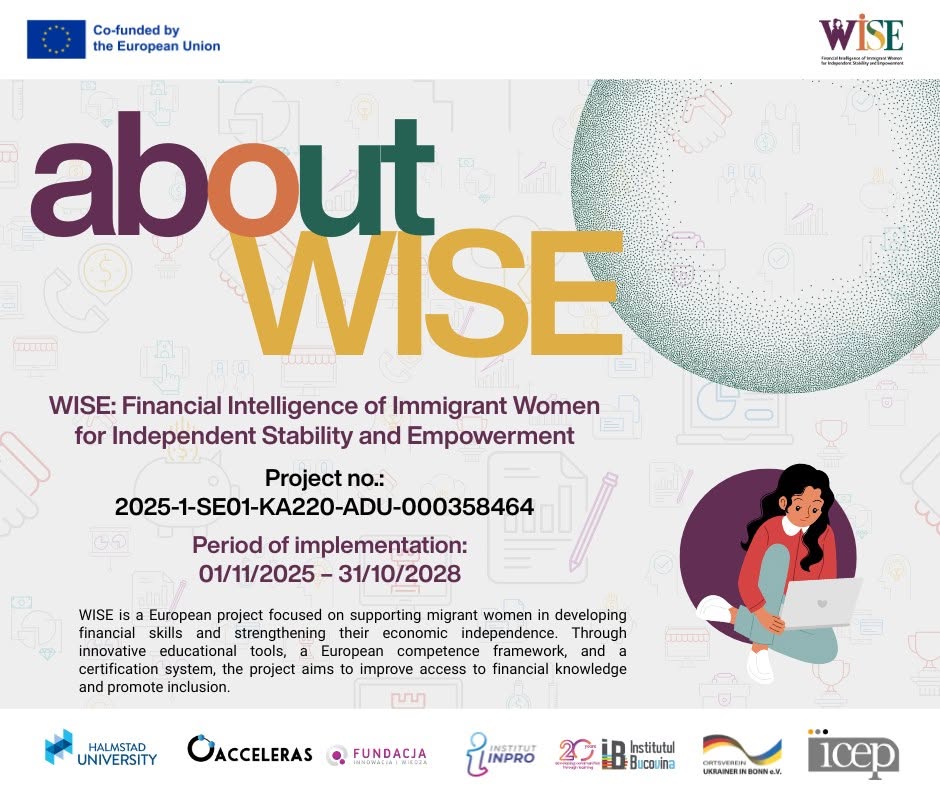
It is within this context that the European project WISE – Financial Intelligence of Immigrant Women for Independent Stability and Empowerment aims to make a difference. Through practical financial education, WISE4WOMEN seeks to support migrant women in making informed decisions, managing their personal finances more confidently and strengthening their economic independence.
The international partnership is working to develop accessible learning resources adapted to the needs of migrant women across Europe. The project also supports educators and professionals who work directly with migrant communities, providing tools and methods for delivering financial education in an inclusive and understandable way.
The WISE4WOMEN consortium combines experience in social inclusion, education and community-based support to develop and implement activities that respond to the needs of migrant women. Financial education connects everyday decisions about budgets, savings and financial services with wider opportunities for independence and participation.
The project brings together organisations from seven European countries: Halmstad University from Sweden, Acceleras from Austria, Fundacja Innowacja i Wiedza from Poland, Institut INPRO, a.s. from Czechia, Bucovina Institute from Romania, Ukrainer in Bonn e.V. from Germany and ICEP – Institute of European Certification of Personnel from Slovakia.
By combining expertise in education, training and social inclusion, the partners aim to create resources that respond to real needs and can be used in different European contexts. Sharing good practices and developing practical materials will help educators and community organisations support migrant women in building financial knowledge and confidence.
Through WISE4WOMEN, the partnership is working towards a future in which more women have access to the knowledge and support they need to manage their finances and participate fully in the economic and social life of their communities.
More information about the project, its objectives, activities and future results is available on the WISE website: https://wise4women.eu/.
Future project communications will share updates, introduce partner organisations and present the activities and resources developed within WISE.
No responses yet